
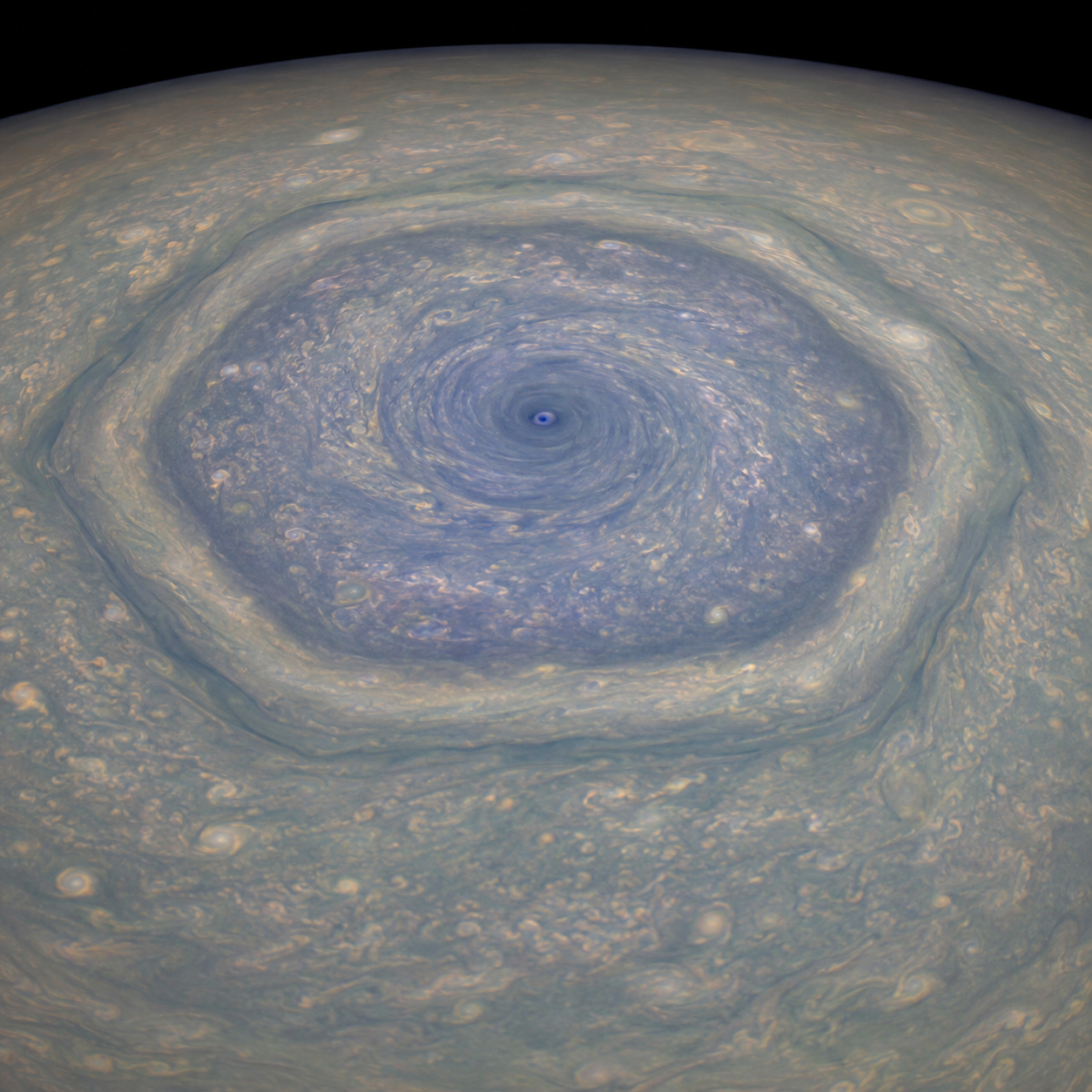
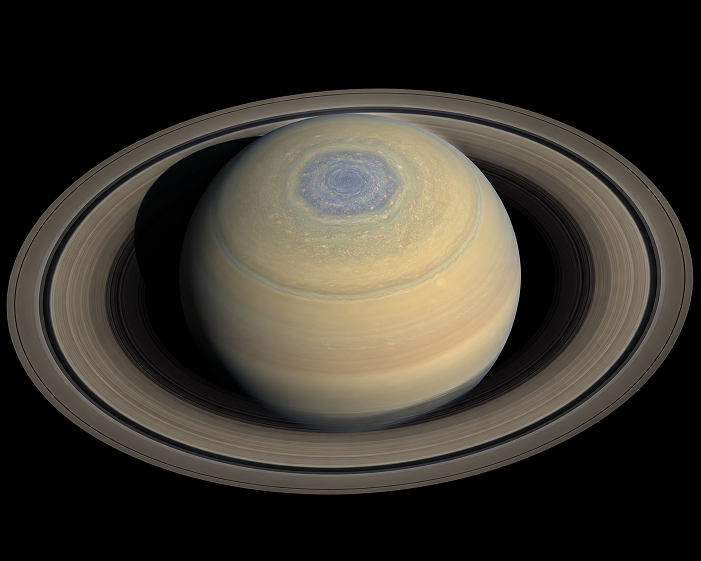
Saturn’s Hexagon: Space just gets stranger and stranger. Saturn is famous for its bright rings, but it also holds one of the most unusual weather features in the solar system. Located at the exact centre of its north pole is a massive, six-sided cloud pattern known as the hexagon. This geometric shape is not an optical illusion. It is a permanent atmospheric phenomenon that continues to challenge our understanding of planetary weather systems.
Saturn’s Hexagon: Discovery and Scale
The polar structure was first spotted by NASA’s Voyager 1 and Voyager 2 missions during their flybys in the early 1980s. Decades later, the Cassini spacecraft arrived to take high-resolution images, confirming that the shape had remained completely intact despite years of changing seasons.
The scale of this geometric vortex is immense. The hexagon measures roughly 30,000 kilometres wide, making it large enough to hold more than two entire Earths side by side. At its very centre lies a roaring polar cyclone with an eye that is approximately fifty times wider than an average hurricane on Earth. While the north pole exhibits this perfect polygon, the south pole of Saturn features a traditional, circular vortex.
How Do Planetary Winds Form a Hexagon?
The shape is actually a towering jet stream flowing eastward at speeds of about 320 kilometres per hour. Instead of moving in a loop, the path of the wind bends into six distinct sides.
For years, scientists debated whether this feature was a shallow cloud layer or a deep atmospheric structure. According to research published in the Proceedings of the National Academy of Sciences, computer models of deep rotating convection show that the phenomenon likely extends thousands of kilometres down into the interior of the gas giant (Yadav & Bloxham, 2020). The sharp changes in wind speed at this specific latitude create a standing wave, known as a Rossby wave, which locks the jet stream into a stable, multi-sided polygon.
Saturn’s Hexagon: Modern Observations and Resources
While a standard backyard telescope will easily reveal the beautiful rings of Saturn, glimpsing the polar region requires ideal atmospheric conditions and advanced imaging equipment.
For updates on planetary photography and deeper insights into outer solar system physics, publications like Space.com regularly share the latest findings from the James Webb Space Telescope. Understanding how these massive storms maintain perfect symmetry helps scientists decipher not only the atmosphere of Saturn but also the fluid dynamics of giant planets across the universe.