Northern Loop: The president of the Royal Institute of British Architects has put forward a sweeping proposal to connect nine major cities across Britain and Ireland through a single high-speed rail network. This would create what he describes as a dispersed but deeply connected metropolis of around ten million people.
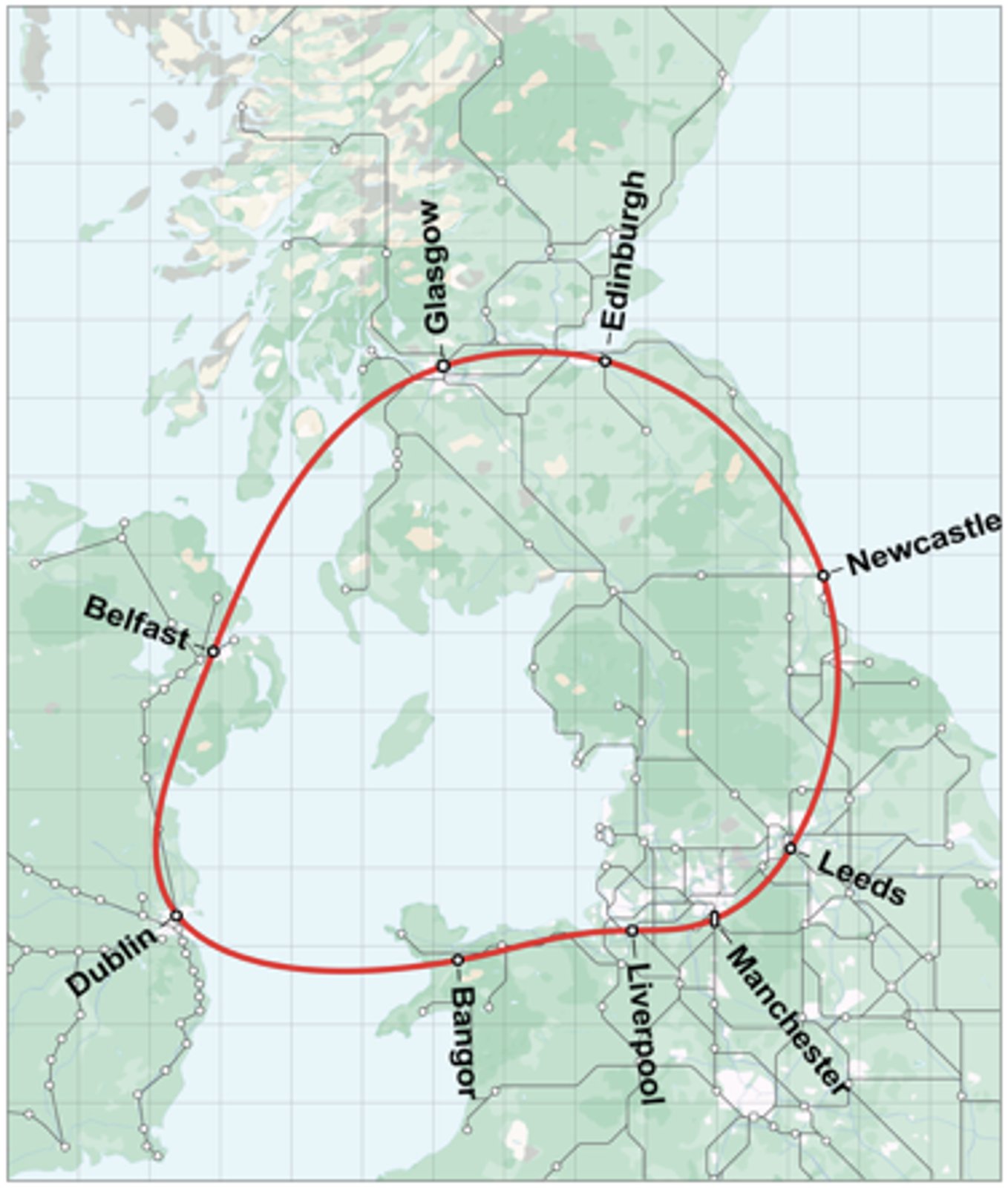
Chris Williamson, who currently holds the RIBA presidency, says the proposed route would thread together Glasgow, Edinburgh, Newcastle, Leeds, Manchester, Liverpool, Bangor, Dublin and Belfast. These cities today feel separated by geography, politics and patchy infrastructure. But Williamson believes it could function as a single economic powerhouse if properly linked.
All pics by Chris Williamson of the Royal Institute of British Architects (RIBA)
Northern Loop and Williamson’s Giant Idea
Williamson spent recent years working on high-speed rail stations for the LINE project in Saudi Arabia, the controversial 170-kilometre linear city planned for the desert. He returned convinced that ambition on that scale shouldn’t be reserved for the Gulf. He submitted the Northern Loop to the Royal Academy’s 2026 summer exhibition in February, and the proposal is already generating considerable discussion.
All pics by Chris Williamson of the Royal Institute of British Architects (RIBA)
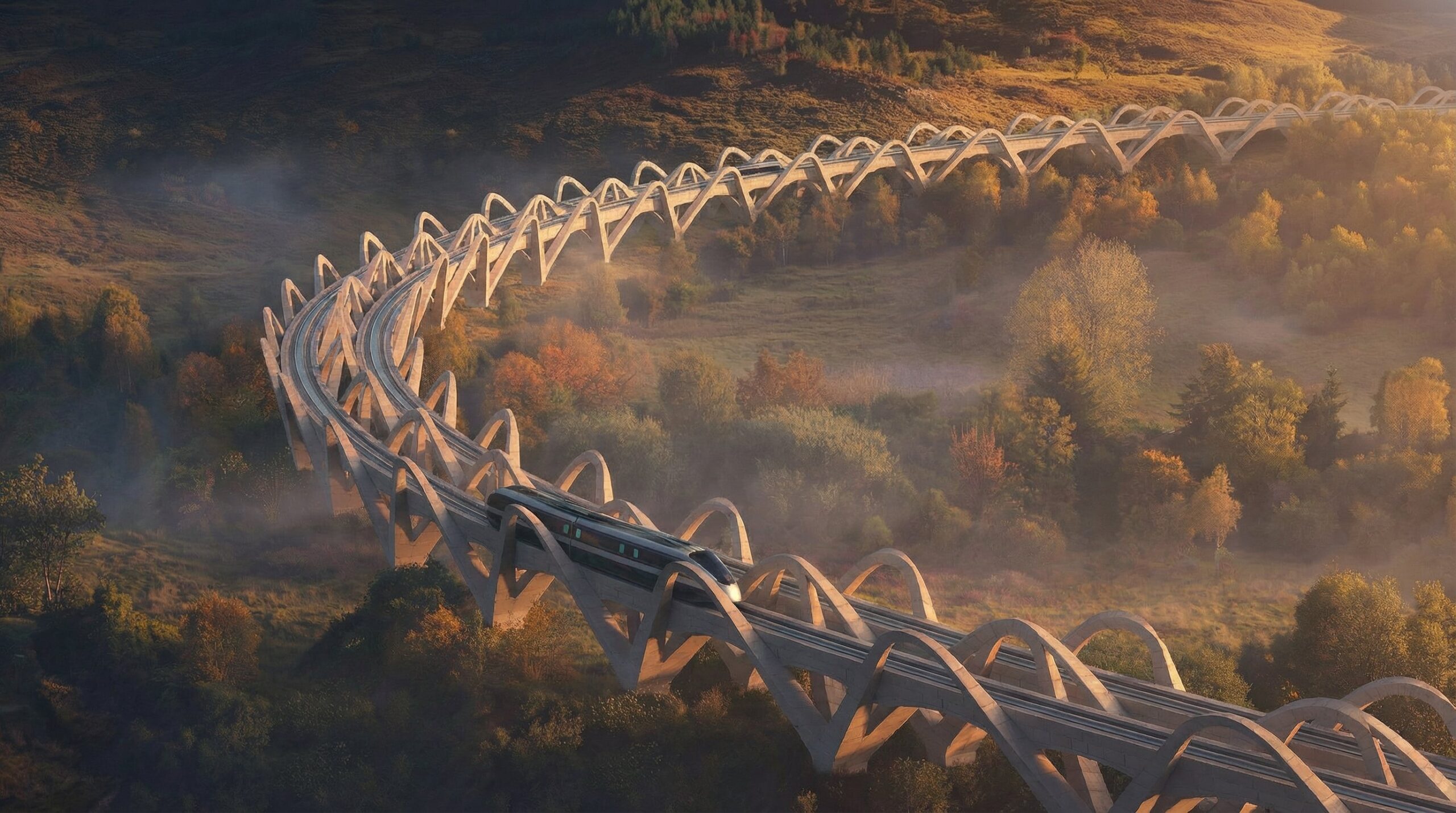
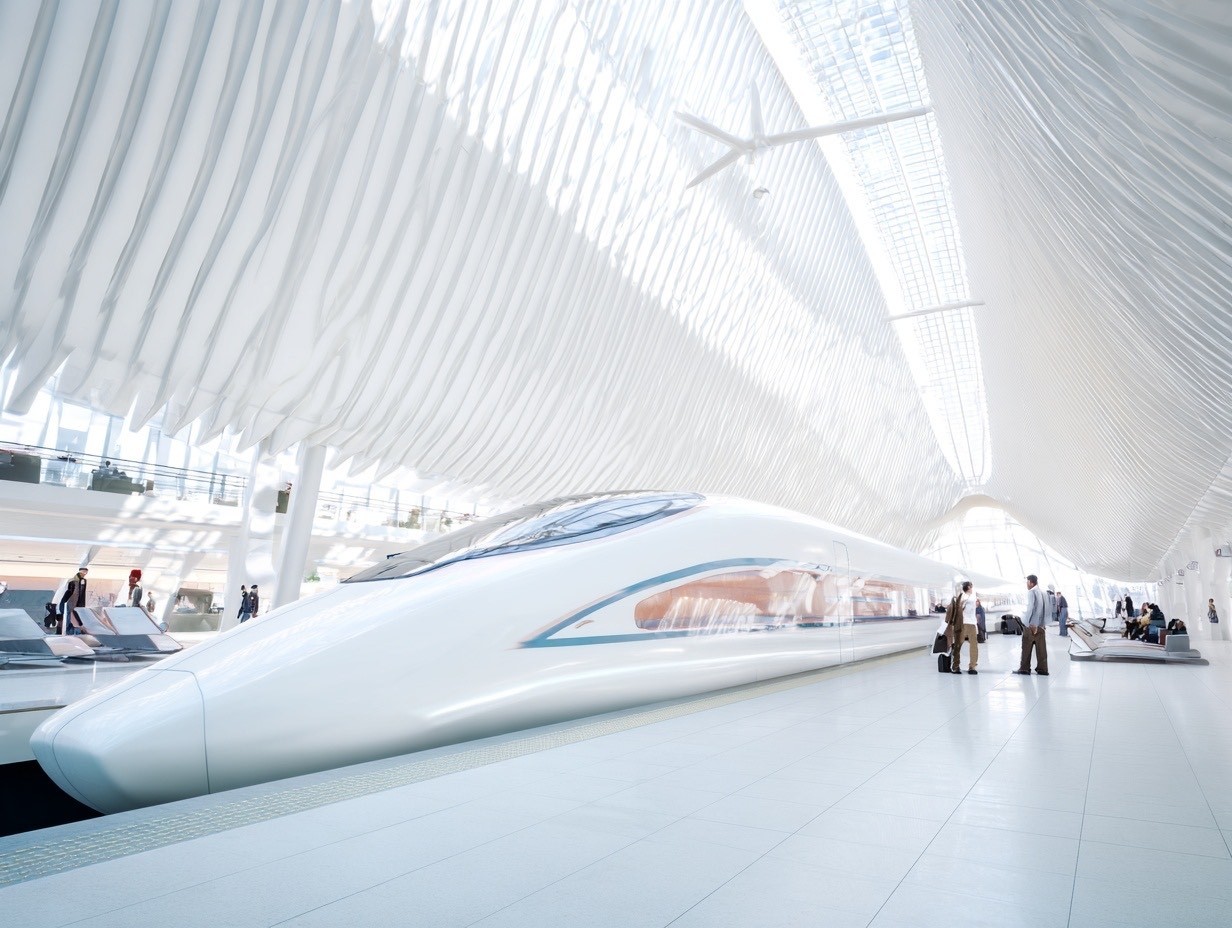
The vision is technically bold. Trains would run every five minutes at speeds reaching 300 miles per hour. The line would be raised on stone arches sourced from local quarries. This is an aesthetic nod to the Victorian railway tradition while minimising disruption to the landscape beneath. Engineering firm Elliott Wood has been involved in developing the structural thinking from an early stage.
Beyond moving people, the loop is conceived as an energy spine. Infrastructure running alongside the rail corridor would capture and redistribute power from onshore and offshore wind sources, supplemented by small modular nuclear reactors positioned at key points along the route. The nine cities, each with their own areas of academic and industrial expertise, would in theory amplify each other’s economic potential simply by being better connected.
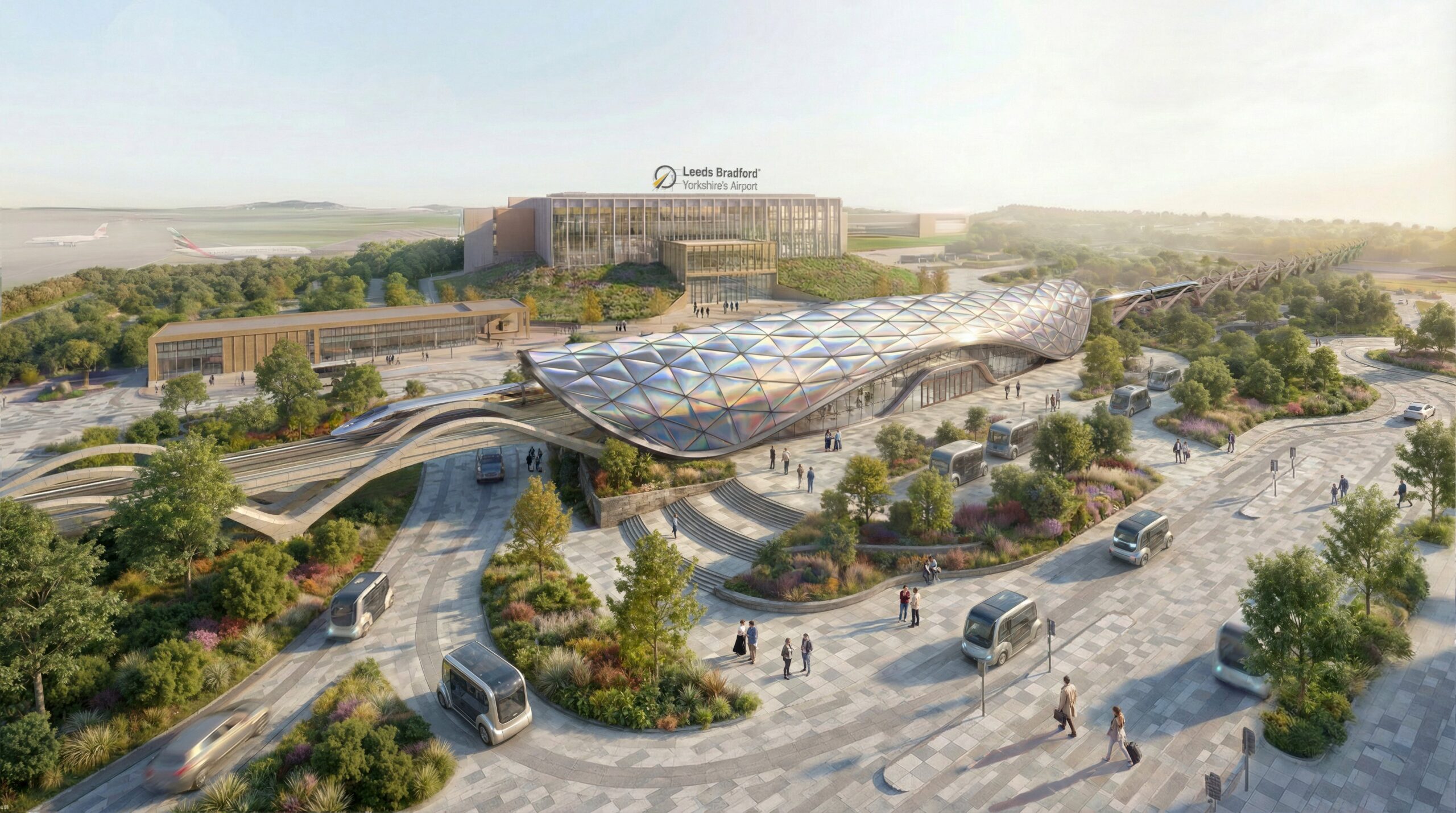
Cost of Construction
Williamson puts the construction cost at £130 billion, with projected annual economic returns of £12 billion.
The Northern Loop is, at this stage, a manifesto rather than a blueprint. Williamson frames it deliberately in those terms, calling for architects to once again publish bold ideas that inspire public debate rather than wait for government commissions. Whether or not it ever gets built, it is a challenge to the prevailing logic of cities competing against each other for scraps of investment, when the alternative, building genuine connectivity, might serve everyone far better.
Old Moore’s Ireland-UK Bridge Vision
The Northern Loop and the Old Moore Almanac’s vision for a physical bridge or causeway connecting Ireland to the UK share a common instinct: that the Irish Sea is a problem to be solved rather than a boundary to be accepted.
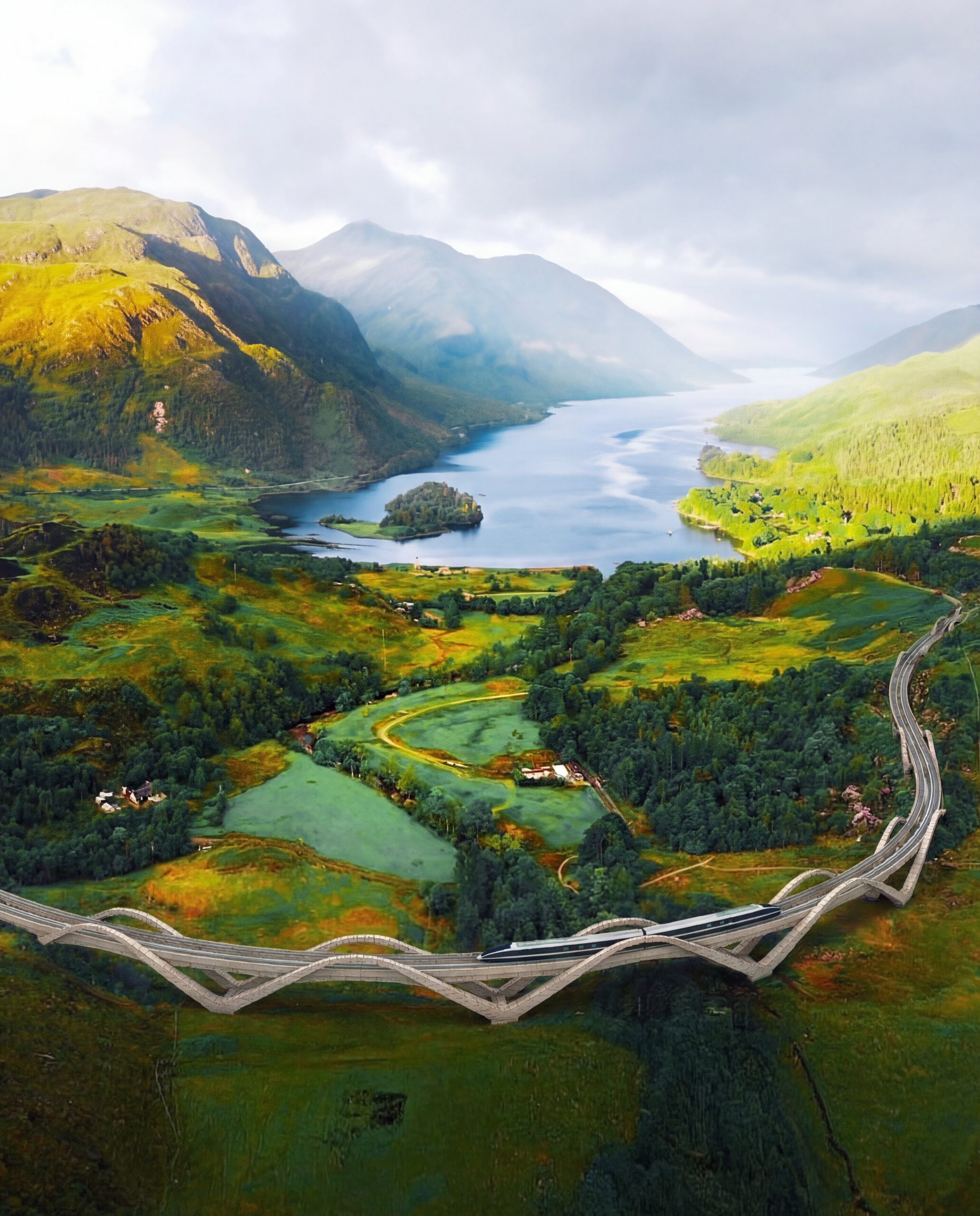
All pics by Chris Williamson of the Royal Institute of British Architects (RIBA)
Old Moore’s vision imagines a fixed link between Ireland and Britain that is more than just a transport corridor. The Almanac’s conception incorporates solar panels along the structure’s length, wave energy capture from the sea below, and wind turbines exploiting the notoriously blustery conditions of the Irish Sea. Crucially, it also envisions the bridge itself becoming a destination: hotels, cafes, housing and public spaces built along the span, so that the crossing becomes a place people inhabit rather than simply pass through. In that sense it echoes the famous inhabited bridges of medieval Europe: Old London Bridge with its shops and houses reimagined for the 21st century with renewable energy generation woven into the fabric of the structure.
Williamson’s Northern Loop shares the energy distribution ambition. His rail corridor similarly doubles as a power network. The two proposals overlap geographically.
Old Moore’s Vision and the Northern Loop
The Almanac vision makes the crossing itself the spectacle. It is a linear community floating above the waves. The Northern Loop is more conventionally infrastructural in character, focused on speed and economic integration rather than the idea of living on the journey.
Together, the two visions actually complement each other rather well. A renewable-powered inhabited bridge between Ireland and mainland Britain, is already fascinating.
Then, feeding into a 300mph rail loop connecting Dublin and Belfast northward and eastward to Edinburgh, Glasgow, Manchester and beyond, would constitute something genuinely unprecedented. It would be a piece of infrastructure that is simultaneously a city, a power station and a transport network. Whether either proposal survives contact with planning systems, geopolitics and financing is another matter entirely, but as tantalising ideas, they are worth thinking about.