Mini ice age. Is it coming, just as Old Moore’s Almanac of 2026 predicted? The Gulf Stream is weakening, are pre-conditions met?
Ireland has always had a complicated relationship with its weather. We complain about the rain, we marvel at the odd sunny day, and we console ourselves that at least we are not Canada. And yet, geographically speaking, we should be Canada. Dublin sits at roughly the same latitude as parts of Newfoundland and southern Alaska. The reason we are not enduring nine-month winters has nothing to do with luck and everything to do with a vast, invisible engine in the Atlantic Ocean.
That engine is the AMOC, the Atlantic Meridional Overturning Circulation, which most people know through its most famous component, the Gulf Stream. The idea that the Gulf Stream has cultivated a particularly mild and wet national climate has become deeply entrenched in the cultural identity of Ireland. James Joyce understood it. In Ulysses, Stephen Dedalus refuses a bath on the grounds that all Ireland is washed by the gulf stream and the weather will sort him out soon enough. He may not have been wrong, but whether future generations of Irish people can make the same assumption is no longer a given.
Mini Ice Age: Predicted by Old Moore
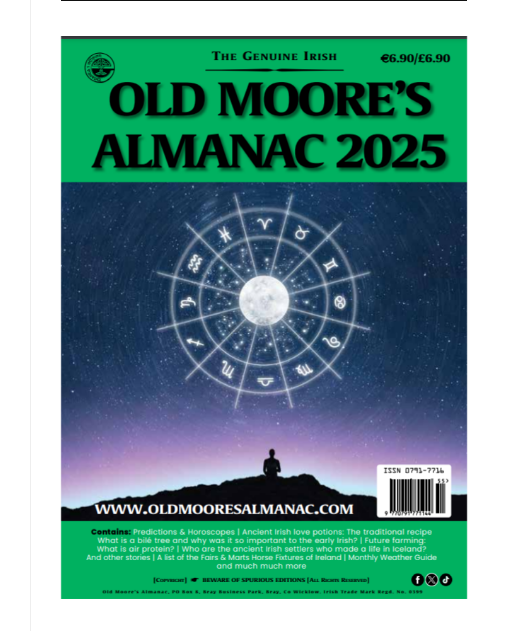
Old Moore’s Almanac, in its 2026 edition, predicted that the preconditions for a mini ice age would be met this year. While this seems striking given the last decade’s focus on global warming, the prediction draws on a body of research suggesting that natural and oceanic factors could trigger abrupt or localised cooling. At the time of publication, many readers may have raised an eyebrow. But the science has been piling up, and it is not particularly reassuring.
The Current is Slowing. Are the Mini-Ice Age Conditions Met?
The AMOC is a tipping element in the climate system and may collapse under changing forcing conditions. What scientists have been watching with increasing unease is not a sudden cliff-edge moment, but a gradual, measurable decline. Current climate models predict a slowdown of the AMOC by 34% to 45% by the end of the century. Some projections go further: under high emissions scenarios, weakening of 17% to 55% is projected by 2100.
That range is wide, and scientists are careful to avoid alarmism. But even the conservative end of those projections carries real consequences for this island.
The Atlantic between Ireland and Canada is behaving strangely. Since the beginning of the 20th century, this region of the Atlantic is the only location on the surface of the earth that has cooled. That anomaly, a cold patch in a warming world, is itself considered a warning sign of AMOC stress. Satellite altimetry from 1993 to 2024 shows a significant northward trend in the Gulf Stream near Cape Hatteras, which is confirmed in subsurface temperature observations going back to 1965, and researchers say abrupt Gulf Stream shifts of this kind can serve as early warning indicators of AMOC weakening and eventual collapse.

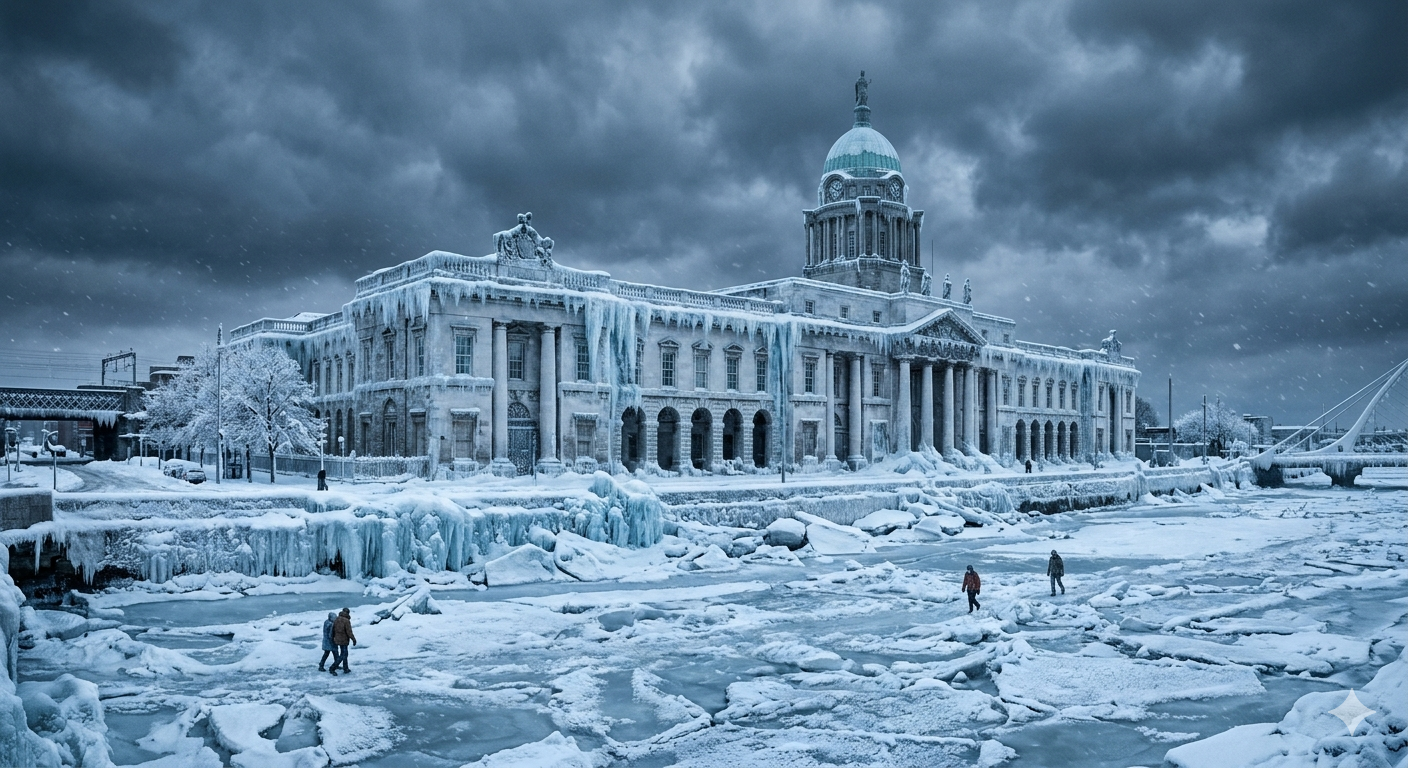
Ice skating in Stephen’s Green?
Mini Ice age? What it would mean for Ireland
Studies suggest that Ireland could experience a temperature drop of 2 to 4 degrees, particularly in winter, along with drier summers. The west of Ireland might see wetter winters due to stronger storm activity. That may not sound catastrophic in isolation, but layered on top of a climate system already under strain, the knock-on effects for agriculture, infrastructure and everyday life would be considerable.
A more extreme scenario, a full AMOC collapse, produces numbers that are genuinely shocking. Scientists at the Royal Netherlands Meteorological Institute and Utrecht University predict that 32% of days per year in Dublin would go below zero, some 95 additional days compared to pre-industrial times, while 37 days per year would not exceed zero degrees at all. Belfast would be hit even harder, with 41% of the year below freezing.
Ireland is at the same latitude as parts of Canada and Siberia, and if the AMOC were to weaken significantly or disappear, Ireland’s weather would become more arctic than temperate. The palm trees and cabbage palms that grow in the southwest of the country?
Other thought leaders think that an AMOC collapse is not immediately imminent, but we need to worry more about rising storm activity.
A timing question
The debate among scientists is not really about whether the AMOC is weakening, it clearly is. The argument is about when a tipping point might be reached. Researchers have predicted the AMOC could reach a collapse scenario any time between 2025 and 2095, with a central estimate around mid-century, far sooner than previous projections, though not all scientists are convinced by the underlying modelling assumptions.
If the AMOC stops flowing, not only will temperatures in Western Europe plunge in winter, but global rainfall patterns will be dramatically altered, devastating ecosystems around the world and causing disastrous knock-on effects for agriculture and food supplies.
What Old Moore saw coming
The 2026 edition of Old Moore’s Almanac did not predict an ice age. It predicted that the preconditions for one would be met. That is a more precise and, as it turns out, more scientifically defensible claim. Beyond ocean circulation, other mechanisms could theoretically drive cooling toward mini ice age-like conditions, especially regionally across Europe and North America. These often tie into feedback loops amplified by warming itself, creating a counterintuitive cooling paradox.
Our way of life is adapted to the current mild and wet climate, meaning rapid changes can wreak havoc on Ireland as we know it. It would be unwise to dismiss this as distant-future speculation. The early warning signs are already in the data..