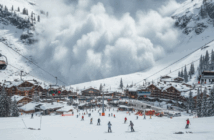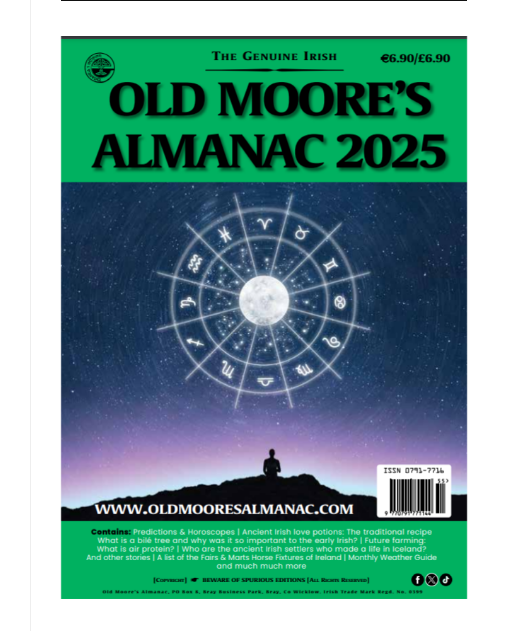
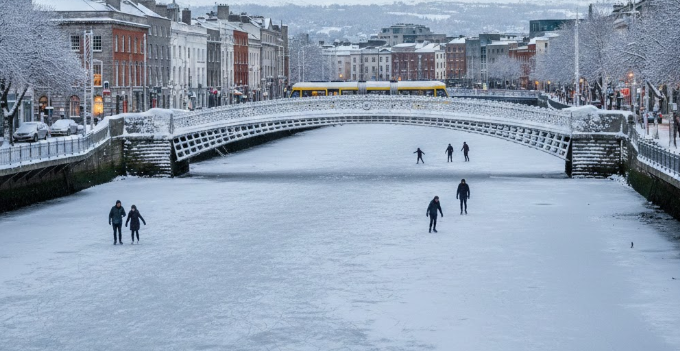
Mini ice age: In the 2026 Old Moore’s Almanac, Old Moore predicted that the pre-conditions for an ice-age will be met. While this seems crazy considering what the climate conversation has been in the last decade (global warming), what if the reverse was what is coming?
Mini Ice Age: How Credible is it?
Some researchers have proposed solar-driven cooling in coming decades. Could 2026 point to a solar cycle that overrides human-induced warming?
The idea of a mini ice age (a period of significant global or regional cooling) sounds dramatic, but it’s not entirely fringe science. While mainstream climate consensus emphasises ongoing human-driven warming, a minority of researchers have long warned of natural factors that could trigger abrupt or localised cooling.
The most prominent claim centres on a grand solar minimum (GSM), where solar activity drops sharply, reducing solar irradiance and potentially leading to cooler conditions. Astrophysicist Valentina Zharkova has been a key voice here. Her model, based on solar magnetic field dynamics, predicts a modern GSM from around 2020–2053, with the deepest cooling in cycles 25–27 (particularly 2030–2040).
She argues this could drop average temperatures by up to 1°C globally, echoing Maunder Minimum conditions during the Little Ice Age.
Recent discussions of her work appear in outlets revisiting 2015 predictions, such as Lab Manager (June 2025 update) and Euro Weekly News (November 2025), which highlight a potential 60% drop in solar activity.
Zharkova’s own site claims global cooling has “arrived,” with steeper declines expected in Solar Cycle 25 by 2026.
Another researcher, Habibullo Abdussamatov, maintains that there will be extended cooling. This will continue for 65 years, peaking, he says, around 2043.
German astronomer and scholar, Theodor Landscheidt predicted a cold period around the year 2030. This is based on an 87-year solar cycle called the Gleissberg cycle.
Mini Ice Age: Factors Other Than Solar Disruption
Beyond solar activity, other mechanisms could theoretically drive cooling toward mini ice age-like conditions, especially regionally (like for example, in Europe and North America). These often tie into feedback loops amplified by warming itself, creating a counterintuitive “cooling paradox.”
The AMOC (including the Gulf Stream, which brings warmer conditions to Ireland) transports warm water northward, keeping Western Europe milder than comparable latitudes. A slowdown, driven by freshwater from melting Greenland ice and Arctic changes, could drastically cool the region.
Recent studies warn the tipping point may be near (within decades), with collapse risks no longer “low-likelihood.” A 2025 Guardian report discusses models showing shutdowns even under low emissions scenarios.
Europe could see winters 5-10°C colder (or more in extremes), resembling Little Ice Age conditions. Iceland has flagged this as a national security threat.
Jet Stream and Polar Vortex Disruptions
The polar jet stream, a fast west-to-east wind river, typically confines cold Arctic air. Warming reduces temperature gradients between the Arctic and mid-latitudes, weakening and “wavier” behaviour, allowing cold outbreaks southward.
This doesn’t cause a full ice age but amplifies extreme winters. Polar vortex weakenings (e.g., via sudden stratospheric warmings) lead to “buckled” jet streams and frigid mid-latitude spells.
Some link this to Arctic amplification from climate change, paradoxically increasing cold extremes in places like the U.S. East Coast or Europe.
Mini Ice-Age: Volcanic Activity Clusters
The Little Ice Age was partly triggered by massive eruptions (e.g., 13th-century clusters) injecting particles that blocked sunlight, initiating sea ice-ocean feedbacks.
Sustained high volcanism could cause short-term global cooling, potentially tipping systems if combined with other factors.
While solar disruption proponents like Zharkova keep the mini ice-age debate alive, evidence points more toward regional cooling risks from AMOC weakening or atmospheric shifts. This is could be fuelled by warming, if further warming does actually occur.
For now, it seems we should buy the coat and boots, as well as the swimwear and sunscreen. All weather gear seems to be the answer!