

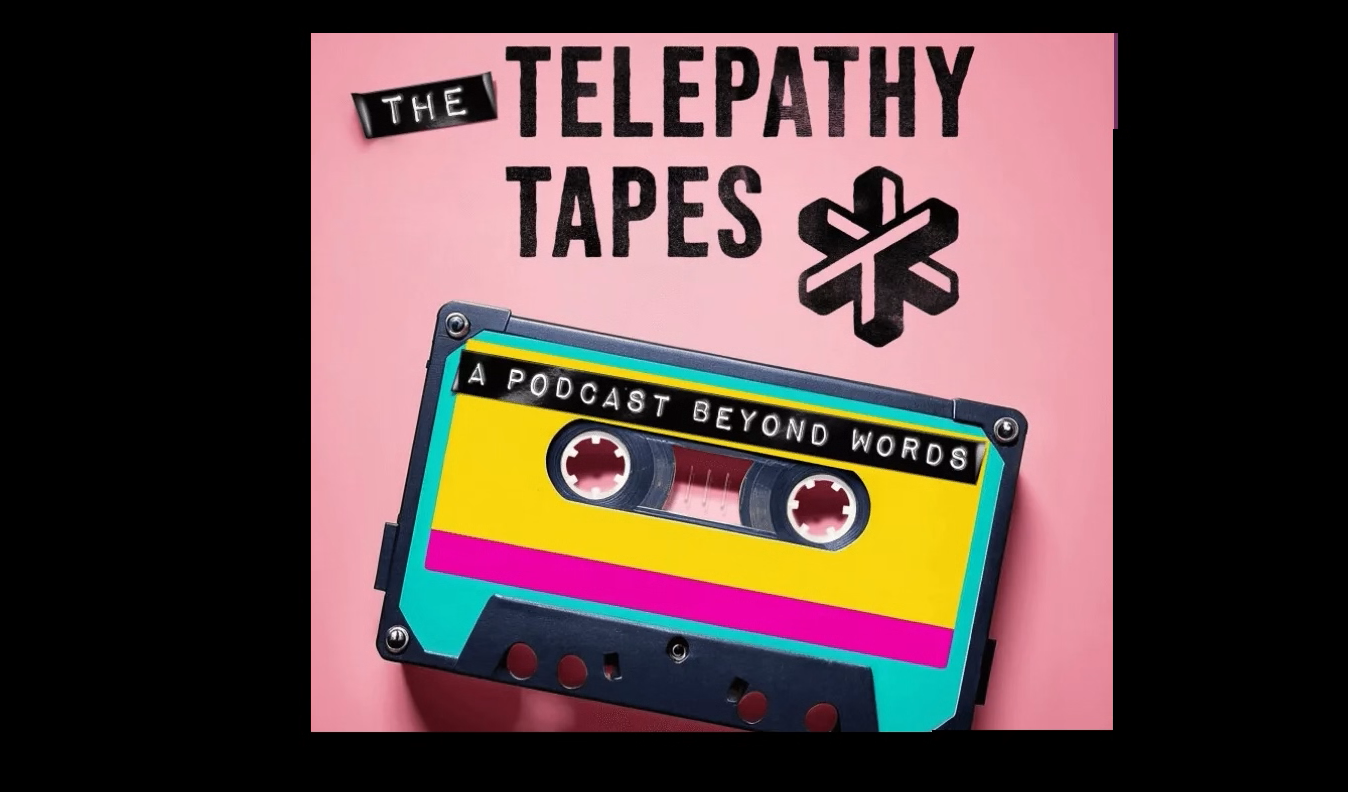
The Telepathy Tapes is a podcast hosted by documentary filmmaker Ky Dickens that has taken the world by storm. By the time the New Year rolled around, it had briefly overtaken the Joe Rogan Experience to become the number one podcast on both Spotify and Apple Podcasts in the United States and the United Kingdom. It currently holds a 4.9-star rating on Spotify with over 2,000 reviews.
The podcast’s central claim is both extraordinary and emotionally compelling: That nonspeaking autistic children possess telepathic abilities. They can read the thoughts of people around them, access some form of shared consciousness, and communicate in ways that mainstream science has refused to acknowledge.
Season 1, released through late 2024, focuses on families with nonverbal autistic children who appear to demonstrate mind-reading abilities in informal tests. Season 2, which began rolling out from October 2025, widens the lens to near-death experiences, animal communication, and broader questions about consciousness.
The Telepathy Tapes: The Core Premise
Each episode of Season 1 introduces listeners to a family, often exhausted, devoted, and desperate for connection with their child. It walks through anecdotes and informal tests that appear to show their child reading words, numbers, or images from another person’s mind without being told what they are.
The children communicate their answers by pointing to letters on a board or typing, usually with a “communication partner” (a parent, teacher, or therapist) nearby. Many episodes feature children apparently spelling out phrases, solving problems, or recalling events they couldn’t plausibly have witnessed.
The podcast also features Dr. Diane Hennacy Powell, a Johns Hopkins-trained former psychiatrist who has spent years investigating what she describes as evidence for extrasensory perception, particularly in autistic individuals. She is the show’s primary scientific voice, and her framework underpins most of the show’s claims.
Beyond telepathy, the podcast ventures into territory that even many open-minded listeners find difficult to follow. For example, there is a shared otherworld where the children telepathically meet. They call it “The Hill.”

Season 2 expands further still, exploring psychokinesis, remote viewing, energy healing, and near-death experiences.
Why Are Parents of Nonverbal Autistic Kids Drawn to This?
To understand the podcast’s appeal, you need to understand the world its audience lives in.
Raising a profoundly nonspeaking autistic child can be an experience of profound grief alongside profound love. Parents often describe years of trying to connect with a child who cannot say “I love you,” cannot explain when they’re in pain, and is routinely underestimated by schools, clinicians, and society. The assumption that inability to speak equals inability to think has shaped how these children are treated for generations.
The Telepathy Tapes offers something radical. It is the idea that their child is not cognitively absent but cognitively extraordinary. That the silence isn’t emptiness, it’s a different channel entirely. For a parent who has spent years wondering what’s happening inside their child’s mind, the suggestion that their child might actually be communicating, even in unconventional ways, carries enormous emotional weight.
There is also a legitimate and important point buried inside the podcast’s more sensational claims. The historical treatment of nonspeaking autistic people as presumptively intellectually disabled has been genuinely harmful, and there is growing mainstream research suggesting that many nonspeaking autistic individuals have far greater cognitive capacity than was previously assumed. The podcast is right to challenge the old “no speech = no thought” framing, even if the methods it uses to do so are deeply contested.
Telepathy Tapes and Facilitated Communication
The majority of the children in the podcast communicate through a method known as facilitated communication (FC) or its related variants: Spelling to Communicate (S2C) and the Rapid Prompting Method (RPM). In FC and related techniques, a communication partner is physically present and often in contact with the child while they point to letters or type.
The problem is that facilitated communication has been extensively studied since the early 1990s, and controlled research has consistently found that it is the facilitator, not the autistic individual, who is unknowingly generating the messages. This is not a fringe view: the American Speech-Language-Hearing Association, the American Academy of Pediatrics, the American Psychological Association, and the American Academy of Child and Adolescent Psychiatry have all issued statements against FC on the grounds that it lacks scientific validity.
The classic way to test this is to show the child and facilitator different information, and then see what gets spelled out. Repeatedly, in properly controlled trials, the answer reflects what the facilitator saw, not the child. This is the test the Telepathy Tapes does not run.
Is There Anything Valuable Here?
Despite the significant criticism, the podcast has sparked a conversation that needed to happen.
The assumption that nonspeaking autistic people lack inner lives has caused real harm. The push to “presume competence”, to treat nonspeaking autistic individuals as potentially more cognitively capable than their speech suggests, is a meaningful ethical shift
A 2025 academic paper in a peer-reviewed journal acknowledged that the podcast “marks a cultural turning point, compelling a reassessment of entrenched scientific frameworks and ethical stances toward nonspeakers” and called for more careful, rigorous research rather than dismissal.
The emotional truth the podcast captures, that parents of nonverbal autistic children have been failed by a system that gave up on their child’s inner life too quickly.
The Telepathy Tapes is a beautifully produced, emotionally powerful podcast that taps into something real: the pain of parents whose children have been underestimated, and the genuine mystery of human consciousness. It is easy to understand why it resonated so deeply.
Where to Listen to The Telepathy Tapes
You can find the podcast on all major platforms:
- Official website: thetelepathytapes.com
- Spotify: Listen on Spotify
- Apple Podcasts: Listen on Apple Podcasts
- Amazon Music: Listen on Amazon Music
- Podbean: Listen on Podbean


