

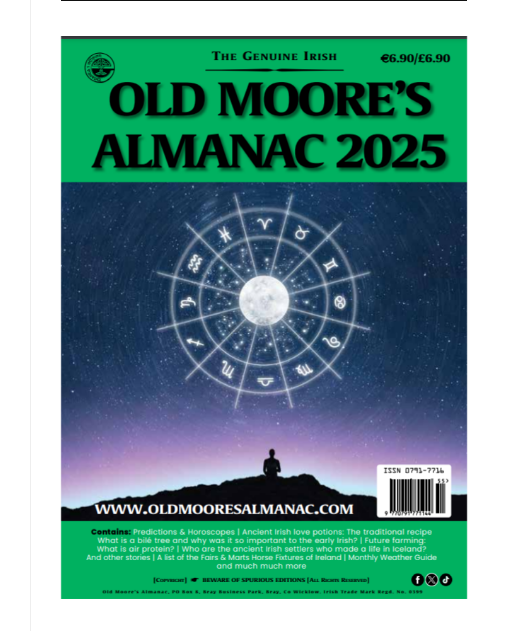
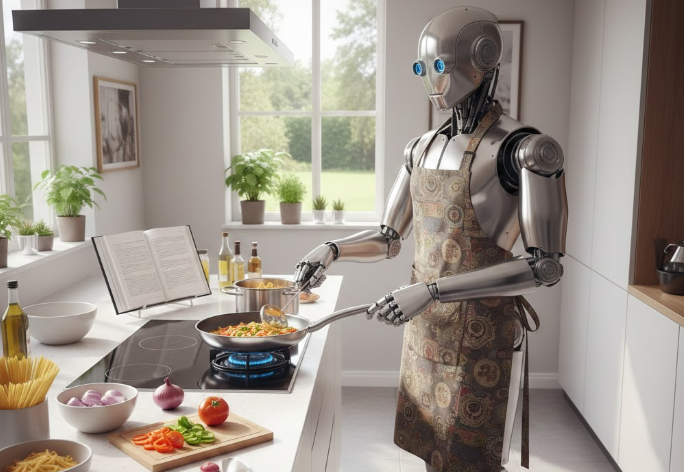
Robots in our homes: Ireland’s legendary Old Moore’s Almanac, a publication with over 260 years of forecasting under its belt, made a bold prediction for 2025: “There will be robots in our homes.”
For many readers flipping through the iconic green-covered almanac, this might have seemed like pure science fiction. However, as we move past 2025, this prophecy appears to be materialising fast. And who wouldn’t want a robot cooking dinner every night?
Robots in Our Homes? Really?
While we haven’t quite reached the point where every household has a humanoid butler like in science fiction films, humanoid robots are transitioning from research labs to real-world applications. Preorders for household robots have surged, particularly in markets with aging populations.
Companies like Xpeng, Tesla, Boston Dynamics, and others have made remarkable advances in humanoid robotics, with several models approaching or achieving commercial viability.
What seemed impossible just a few years ago is now scheduled for mass production within the next 12-24 months.
Perhaps no robot better exemplifies the fulfillment of Old Moore’s prediction than Xpeng’s Next-Generation IRON humanoid, unveiled at the company’s 2025 AI Day in Guangzhou, China, in November 2025.
Robots in our homes: Why IRON Made Headlines Worldwide
When IRON walked onto the stage at Xpeng’s AI Day, something extraordinary happened: the audience didn’t believe it was real. The robot’s movements were so fluid, so eerily human-like, that viewers worldwide insisted there must be a person inside a suit.
@by20_50 XPeng’s Robot Is Too Real #By2050 #HumanoidRobot #FutureTech #XPeng #Robotics #AI #Android #FutureHuman #UncannyValley #TechShorts #ArtificialIntelligence #HumanLikeRobot #NextGenTech #SciFiBecomingReal #RobotsOfTheFuture
The skepticism grew so intense that CEO He Xiaopeng was forced to take drastic action. Just 24 hours after the initial reveal, he returned to the stage with scissors and cut open IRON’s leg to reveal the machinery beneath the synthetic skin. This dramatic demonstration finally convinced doubters that they were witnessing genuine robotic innovation, not theatrical trickery.
The question of IRON’s realism can be examined from multiple perspectives:
Visual and Movement Realism: Exceptionally High
IRON represents what Xpeng calls a “born-from-within” design philosophy. Unlike traditional robots that simply wrap mechanical components in a humanoid shell, IRON is built to replicate human anatomy from the inside out:
- Humanoid spine: A central column that mimics the human vertebral structure
- Bionic muscles: Synthetic muscle frameworks that stretch and contract like human tissue
- Flexible synthetic skin: Full-body coverage that moves naturally with the robot’s motions
- 82 degrees of freedom: Comprehensive articulation throughout the body
- 22 degrees of freedom per hand: Using the industry’s smallest harmonic joints to achieve 1:1 human hand size
The result? A robot that can perform a catwalk with hip sway, maintain natural posture, and execute fluid movements that convinced many observers it was a human performer.
Robots in our Homes: Technical Capabilities
IRON runs on cutting-edge technology:
- VLT (Vision-Language-Task) AI model: Core decision-making engine for autonomous actions
- VLA (Vision-Language-Action) model: Adapted from Xpeng’s autonomous driving technology
- Three Turing AI chips: Delivering 2,250 TOPS (trillion operations per second) of computing power
- All-solid-state battery: Industry-first application providing lightweight design with high energy density
These systems enable IRON to hold conversations, walk naturally, interact with humans, and perform complex tasks.
Customisation and Personalisation: Groundbreaking
One of IRON’s most innovative features is its customisable design:
- Adjustable height and physique
- Different body types available (slimmer or stockier builds)
- Customizable gender presentation
- Modifiable synthetic skin for different contexts
This flexibility aims to make humanoid robots less alien and more relatable, potentially easing their integration into homes, offices, and retail environments.
The Commercial Roadmap: When Can You Actually Get One?
Xpeng has announced ambitious but concrete plans: Xpeng aims to achieve mass production of advanced humanoid robots by the end of 2026.
IRON isn’t operating in a vacuum. The humanoid robot market exploded in 2025:
- NEO robots: Experiencing skyrocketing preorders for household assistance
- Tesla Optimus: Continuing development with workplace and eventual home applications
- Boston Dynamics: Advancing Atlas humanoid capabilities
- Chinese Competition: Multiple companies including Unitree showcasing impressive humanoid capabilities
The driving forces behind this surge align perfectly with Old Moore’s prediction: aging populations in developed nations seeking assistance with daily tasks, labor shortages in service industries, and rapidly improving AI capabilities making truly useful robots feasible.
What Old Moore’s Prediction Really Tells Us
Whether you believe in the mystical origins of Old Moore’s prophecies or attribute them to insightful trend analysis, this particular prediction for 2025 has proven remarkably prescient. We may not have robots in every home quite yet, but:
- Humanoid robots have transitioned from science fiction to commercial reality in 2025
- Pre-orders and commercial deployments are accelerating rapidly
- Technology demonstrated by robots like IRON shows human-level movement is achievable
- Mass production timelines suggest widespread availability is imminent.
Old Moore’s Almanac has predicted “robot romance stories” and continued technological advancement. Given the publication’s track record, this forecasts warrants attention.


