What is the Planting Moon? And why do some people call it the Pink Moon?
Every April, the full moon rises with a name that sounds like it belongs on a paint swatch rather than in the sky. The Pink Moon. It does not, as many assume, glow rose or blush or salmon. So where did the name come from? And did the Irish ever use it?
The short answer is no. The name “Pink Moon” is not Irish in origin. It is a term borrowed from Native American traditions, where it heralded the blooming of moss pink, a spring wildflower that carpets the ground across parts of North America in early spring.
According to Celtic tradition, the April full moon was known by a different name altogether: the Growing Moon. It also went by Planting Moon, Seed Moon, and Budding Trees Moon: names rooted in the practical rhythm of the land rather than in the colour of a flower that does not even grow here.
What the Irish Called It
In Irish, the moon itself is an ghealach, which literally means brightness. There is no single surviving Irish name for the April full moon in the way that the Harvest Moon has embedded itself in Irish speech and tradition. What survived instead was a body of lunar lore, farming wisdom, superstition, and prayer, that treated the moon not as a named object of wonder but as a living, governing force.
A Moon That Ran the Country
The old Celtic druids placed great emphasis on the moon and arranged their calendar by it. It was believed that any work or business undertaken when the moon was growing (waxing) would be successful. Work begun when the moon was waning was considered less likely to succeed.
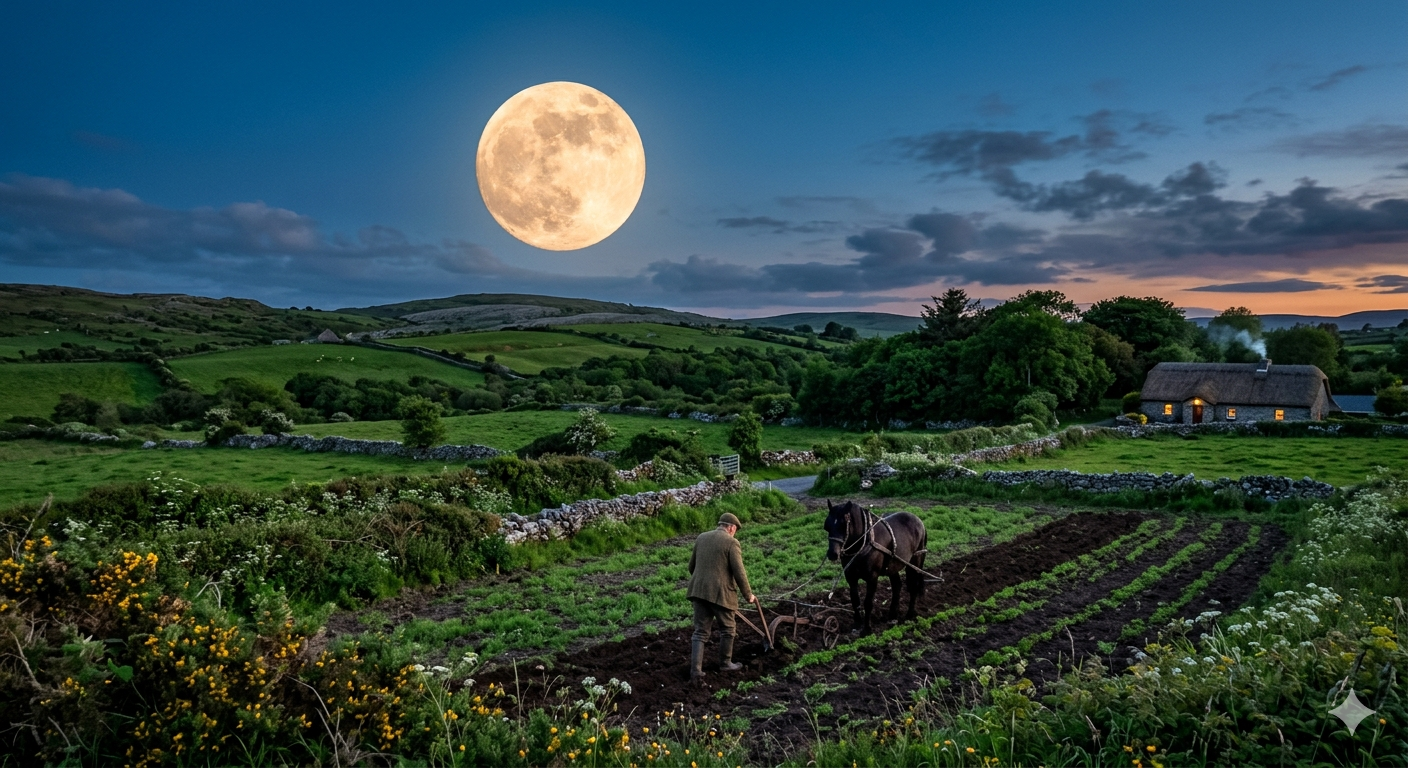
The April moon arrived at a critical moment in the agricultural calendar. In Irish farming tradition, it signalled the time to plant hardy vegetables: spuds, onions, cabbages, and carrots. These are crops that could withstand a cool snap or a last-minute squall. This aligns with lunar planting wisdom, where the waxing moon favours planting crops that grow above ground, and the waning moon suits root vegetables and pruning.
It was considered good practice to set seeds as the moon waxed. Scollops for thatching the roof were cut as the moon increased, ensuring their continued strength. Pigs and sheep were usually killed while the moon was waxing. the bacon or mutton would swell in the boil, as the saying went. The moon was less a romantic spectacle and more an operating system for rural life.

Planting Moon: Magic and Superstition
A child born when there was a new moon was thought to have good prospects for health and wealth. The energy caused by the full moon was believed to be overpowering to the human spirit, and a person who became over-elated by it was said to have gone “le gealaí”, with the moon. In English, we have the word “lunatic” from the Latin for moon, “luna.” The word “moonstruck” carries the same meaning.
There was a particular tradition of money magic with the new moon: “Whatever you have in your hand when you see the new moon first, you will have plenty of that before the next new moon comes.”
For the wise women and hedge witches of Ireland, the Planting Moon brought its own small magic. Spring herbs gathered under its glow were said to have extra potency, and dew collected the next morning was used for everything from skin health to blessing newborns.
Planting Moon: Look up Tonight!
The April 2026 full moon will reach its peak just after 3am on the 2nd of April. This Full Moon is also the Paschal Full Moon, which means it helps determine the date of Western Easter. For Irish observers, that meant a bright moon visible across the island on the night of the 2nd of April, riding high over the midlands and catching the early spring fields in its light.
The April moon over Ireland has always meant something more grounded than its borrowed American name suggests, the ground soft enough to dig, the days long enough to work, the year tilting at last toward warmth.